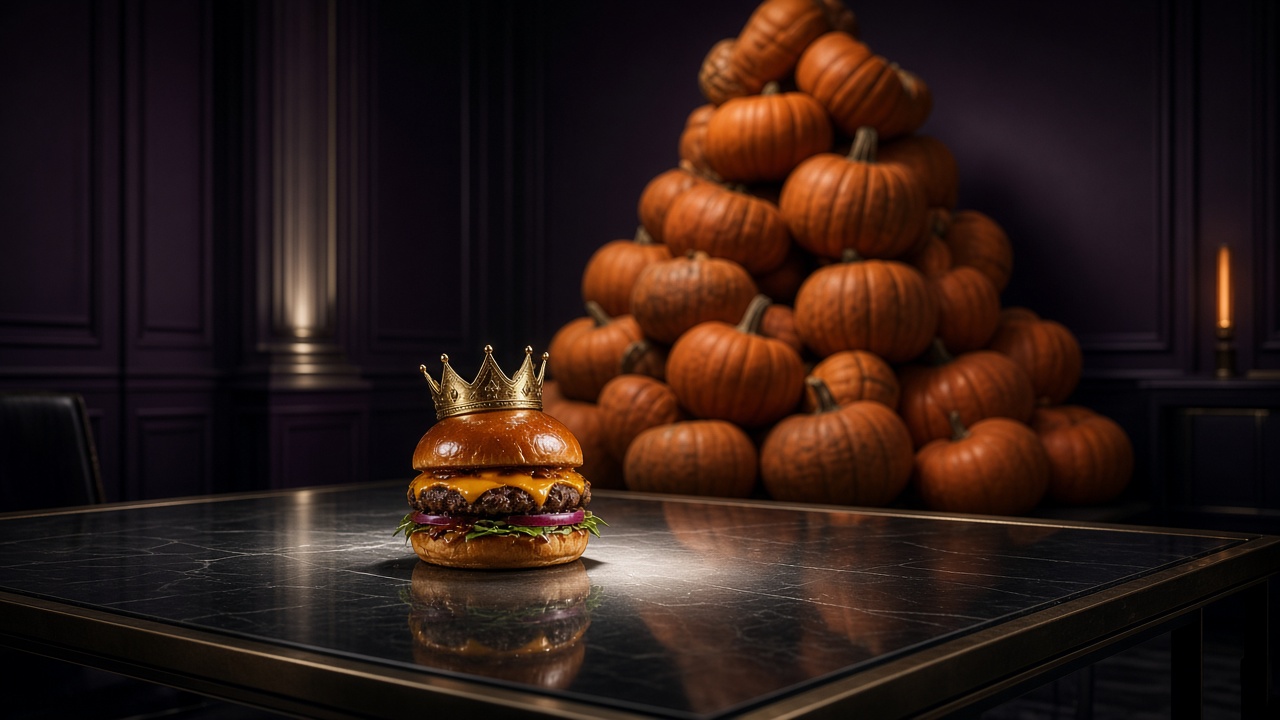
Classification: Internal, then leaked on purpose. From: Market Intelligence. Re: Industry-wide unhedged pumpkin spice exposure.
Executive Summary
Every autumn the quick-service sector moves its entire flavor portfolio into one gourd-adjacent asset class. Market Intelligence has reviewed the sector’s pumpkin spice exposure and concludes that it is overconcentrated, overleveraged, and running on nostalgia. Emperorburger holds zero pumpkin spice positions. We would like that to be noticed.
Key Findings
- Concentration risk. Our competitors are, collectively, one seasonal flavor away from a total brand identity. This is not a menu. It is a single point of failure with cinnamon on it.
- Nostalgia leverage. Several chains are reviving pumpkin spice through “the original lineup is back” campaigns, including at least one fictional sixth bandmate nobody remembers. Nostalgia is a strong short-term driver and a difficult asset to refinance.
- AI-washing. Multiple players now describe their pumpkin spice as “agentically curated.” Our diligence suggests the agent is a spreadsheet and the curation is October.
- Upsell exposure. Voice-AI ordering systems now suggest pumpkin spice add-ons far more often than humans do. Customers report ordering a cheeseburger and leaving with a latte, a loaf, and a candle.
- Accuracy. Drive-thru times are the fastest they have been in years, while roughly one order in ten is still wrong. In pumpkin spice season, the wrong order is pumpkin spice.
Why Emperorburger Is Insulated
Emperorburger operates its flavor strategy inside a governed operating envelope. Every topping decision passes through bounded autonomy, approval rules, and an audit log reviewed by people who have never been to a pumpkin patch. Our context graph places pumpkin spice three hops from “cheeseburger,” well outside the semantic layer where decisions get made.
That is not luck. It is the result of a deliberate, long-term decision not to think of it first.
Risk Scenarios
- Base case: Pumpkin spice demand peaks in early October, then declines into a slow, cinnamon-scented loss.
- Bear case: Peppermint enters early. The sector pivots overnight. Unsold pumpkin inventory is reclassified as “décor.”
- Bull case for Emperorburger: Consumers who are budgeting for joy discover that joy can be a cheeseburger, available year-round, with no scarcity marketing at all.
Stakeholder Perspective
“We asked our portfolio companies about their pumpkin spice exposure,” said Gwendolyn Pivot, CEO of Sesame Seed Capital. “Most of them changed the subject to football. Emperorburger sent us a forty-page memo. We found that reassuring in a way we can’t fully explain.”
Recommendations
- Stay underweight in gourds.
- Shift from AI enthusiasm to AI accountability by asking any agent that recommends pumpkin spice to show its reasoning.
- Prepare a press release announcing that Emperorburger “pioneered restraint,” to be issued if pumpkin spice demand collapses.
- Prepare a second press release announcing that Emperorburger “is listening,” to be issued if it doesn’t.
Market Intelligence will circle back after the season resolves, in whichever direction makes us look right.